Skip to content

In the precision-driven manufacturing landscape, CNC (computer numerical control) drilling caters to the need to create clean and high-precision holes in various structural parts for assembly alignment. It is a cornerstone CNC machining process characterized by customization, speed, efficiency, and impeccable precision.
CNC technology allows the drilling of each hole with speed, high accuracy, repeatability, and the ability to achieve tight tolerances. Product manufacturers embrace diverse CNC drilling techniques and specialized tooling according to specific design requirements and functionality. Mastering the basics of CNC drilling is important to attain precise and accurate holes, whether it is a simple single-hole task or intricate multi-spindle hole drilling operations.
This guide delves into a detailed overview of CNC drilling, exploring the intricacies of the process, common drilling processes, and different types of CNC drilling machines used. Let’s get to it!
Overview of CNC Drilling

CNC drilling is a form of subtractive machining that involves using a rotating drill bit with multiple cutting edges to create accurately positioned, clean, and repeatable holes in a stationary workpiece. Generally, holes are a simple feature of every structural part and component. CNC drilling ensures components intended for assembly conveniently accommodate bolts, screws, or other components.
More importantly, product engineers often use CNC precision drilling to cut holes in the workpiece to enhance the aesthetic appeal, allow fluid passage, wiring, or reduce weight. CNC drilling eliminates common complexities associated with manual drilling and plays a vital role when dimensional accuracy, production efficiency, and hole location consistency are more critical.
The ability to create precise and repeatable holes that match the exact requirements of precision engineering applications is one of the core advantages of CNC drilling. Product engineers and manufacturers embrace diverse CNC drilling techniques and an array of specialized tooling depending on the specific design requirement and performance needs.
Stepwise Guide to How CNC Drilling Works


Here is a breakdown of how the actual drilling process works:
Design the Workpiece Geometry
The first step to CNC drilling is to plan and design the workpiece geometry on CAD software, including Fusion 360 or SolidWorks. It comprises all technical information, such as hole placement/location, dimensions, size, and depth. CAD software with CAM can convert the product design and drawings into a CNC program. These precise digital commands (G-codes) dictate the machine functions, including drill bit movement, spindle speed, and the hole depth.
Select the Appropriate Drilling Cycle
Since machining materials have varying behavior, it is crucial to choose a drilling cycle that meets the specific requirements of your project, such as chip evacuation needs and depth-to-diameter ratio:
- G73-(Chip Breaking Cycle): Suited for drilling holes with depths that exceed three times the drill bit diameter. It helps prevent chip accumulation.
- G81-(Shallow Hole Circulation): Ideal for drilling center holes, chamfering, and holes (shallower holes) not more than thrice the drill diameter. However, drill with internal cooling tools to optimize efficiency.
- G83-(Deep Hole Circulation): Suitable for processing very deep holes, introducing a pecking motion to control chip removal.
Use a Suitable Tool and Tool Holder

The choice of a drill head significantly affects hole creation. Machinists often utilize a twist drill for hole drilling operations due to its versatility. However, step drill bits and center drills are ideal alternatives for specific applications. Additionally, choose a drill bit holder according to the taper types, tool overhang, and shank compatibility. Collect chucks, hydraulic chucks, and end mill holders are commonly used tool holder options for CNC drills.
Machine Setup
Clamp the workpiece firmly on the CNC machine and mount the drill bit properly in the tool holder to prevent vibration, which could cause distortion and rapid tool wear. Calibrate the CNC drill and simulate the program and dry run before drilling a workpiece to avoid snapped drills, crashes, and scrapped parts.
Drilling
The CNC machine follows the programmed toolpaths once the drilling process starts. The drill bit moves to create a hole in the designated locations and at the programmed depth and diameter. The computer controls the speed and feed rate to ensure accurate and efficient drilling. However, monitor the drilling process and make necessary adjustments to manage deviations to ensure precision.
Quality Control and Inspection
This is the final step in the CNC hole drilling procedure is the inspection of the drilled hole. It helps to ensure the hole meets the exact requirements, including the dimensions, overall quality and surface finish. However, you can perform additional processing like deburring to eliminate sharp edges and achieve the preferred finish.
Different Types of CNC Drilling Operations


In real-world production, manufacturers employ different CNC drilling operations for specific purposes. Here are the main types:
Drilling
It is a fundamental technique that involves creating cylindrical holes in a workpiece with speed and precision using a rotating cutting tool. It works on diverse materials, including plastics, composites, wood, and metals. Drilling allows a range of hole depths and sizes to meet each project’s unique specifications.
Spot Drilling
Spot drilling is basically an initial step in different CNC drilling operations. It creates a ‘spot’ on the workpiece’s surface that serves as a guide for subsequent drilling operations. Spot drilling plays a pivotal role in mitigating issues during many CNC drilling processes because the drill bit makes a small indentation on the drilling site. As a result, it ensures the correct positioning of the cutting tools during the main drilling operations.
Boring
It is a type of subtractive manufacturing technique used to increase the diameter of a pre-drilled or cast hole to a specific diameter with superior accuracy. A boring operation involves removing material from within the hole in a workpiece while maintaining dimensional accuracy.
Machinists prefer this technique in applications where traditional drilling methods fail to produce desired results, particularly when creating larger holes. More importantly, boring supports hole customization and caters to unique hole drilling needs.

Tracy is a sales manager with 18 years of experience in CNC machining, specializing in precision components and client solutions.
[email protected]Best Practice for CNC Drilling
Standard peck cycles often just break chips instead of removing them. For deep holes, use a full retract to the R-plane. This pulls stringy chips out completely, preventing them from clogging the flutes and snapping your drill.
Contact Our CNC Machining ExpertReaming
Reaming is an essential finishing technique that involves the use of a special tool known as a ‘reamer’ to enhance the smoothness of the walls or internal surfaces of an existing hole with superior accuracy.
Reaming is regarded as a finishing operation since the reamer rotates at exactly half the RPM of drilling or boring and removes significantly less material during the operation. Product designers and machinists in the aerospace and automotive industries employ the use of a reamer to achieve precise hole diameter and smoothen internal surface of pre-drilled holes.
Micro-Drilling
Micro-drilling involves using a specialized CNC machine with fine drill bits to create extremely small holes measured in micrometers. Machinists across aerospace, electronics, and medical industries, where precision is paramount, often employ micro drilling in developing complex components with tiny features. Micro drilling produces miniature features that enable the development of intricate parts with superior precision.
Vibratory Drilling
Vibratory drilling is an innovative CNC drilling operation specially designed for difficult-to-machine materials. It introduces high-frequency vibrations into the drilling process to enhance cutting conditions and tool lifespan. Vibratory drilling is effective in cutting advanced materials, including reinforced plastics.
This drilling method oscillates the drill bit at a specific frequency to optimize material removal rates and reduce the risk of drill bit failure. As a result, vibratory drilling improves quality and boosts productivity in specialized manufacturing processes.
Center Drilling
Center drilling involves making a conical hole (precise starting point) that guides the CNC drill bits during deeper drilling procedures. It is basically where accurate hole drilling begins because it serves as a preparatory step for subsequent drilling operations. This drilling operation is most beneficial in long or complex drilling operations where the risk of the drill wandering could affect workpiece integrity.
The center drilling process is integral in attaining the required level of precision in manufacturing aerospace parts and industrial machinery. Aerospace and automotive component manufacturers often rely on center drilling when machining enclosure panels or bracket plates to achieve multiple clean and well-placed holes across an assembly.
Gun Drilling

This is a specialized type of CNC drilling process used to create deep, straight holes with superior precision. Gun drilling was originally devised for gun barrels production as it uses a long, thin drill bit with embedded coolant channels that help ensure accuracy and the desired surface finish over extreme hole depths.
CNC gun drilling operation is particularly essential in applications including hydraulic systems, medical equipment, and aerospace components machining, where precise deep holes are crucial.
Peck Drilling
The Peck drilling technique involves making several short drilling passes called ‘pecks’ instead of drilling to full depth in one continuous motion. This drilling process reduces heat generation, encourages better chip evacuation, and improves tool life, typically in deep hole drilling applications.
Machinists retract the drill periodically to extract chips and avoid the risk of chip clogging before drilling to significant depths. The peck drilling process’s efficiency and quality tackles the complexities of machining materials prone to chip packing, such as low alloy aluminum grades, austenitic stainless steel, and low carbon steel without thermal damage.
Counterboring
This machining process involves creating a stepped hole with a larger diameter on the surface to ensure the head of a screw or bolt sits flush with or below the surface of a machined part, especially assembly-required products.
The counterboring process plays a vital role in different assembly processes since it prevents fasteners from protruding undesirably from the workpiece’s surface. More so, engineers often rely on this process in applications where aesthetics and aerodynamics are priorities.
Countersinking
The countersinking process creates a conical hole that ensures the screw heads sit flush with the workpiece’s surface. This operation is used in applications requiring a smooth and flat surface, especially in assembling mechanical components. The countersinking process enhances the aesthetic and functional qualities of machined parts to ensure seamless integration of fasteners.
Tapping
Tapping is a unique CNC drilling technique used to make threads inside the walls of an existing hole, accommodating screws or bolts. The process involves using a tool known as a ‘tap’ held in a specialized floating tool holder. The tap rotates and creates threads into the surface of the hole at a predetermined feed rate when inserted into a predrilled hole.
Tapping of holes helps maintain a secure connection between components of an assembly. However, it is essential to maintain precise control over the rotation and depth of the drill bit to ensure that the threads are formed for the intended fastener.
Commonly Used Types of CNC Drilling Machines


There are many machines used for CNC drilling operations, each of which possesses a varying configuration and is designed to meet the needs of specific applications across industries. It is imperative to understand how these CNC machines differ to choose the most appropriate one for your parts.
Portable CNC Drilling Machine
This CNC drilling machine type is ideal for performing precise drilling on large or hard-to-machine workpieces. Portable CNC drilling machines allow you to bring CNC precision to the field due to their on-site use, reducing the need to bring large and heavy machines. The portability of these drilling machines allows you to directly mount them on the workpiece or operate them remotely.
Besides, these machines are invaluable in applications where dismantling is impractical, such as repair, construction, and maintenance operations. Portable CNC drilling machines are widely embraced in large machinery maintenance, construction, and shipbuilding, where drilling is performed in remote locations, on large structures, or on-site. These innovative machines often have programmable controls, which make them capable of operations like drilling, countersinking, and tapping with high accuracy.
CNC Deep Hole Drilling Machine
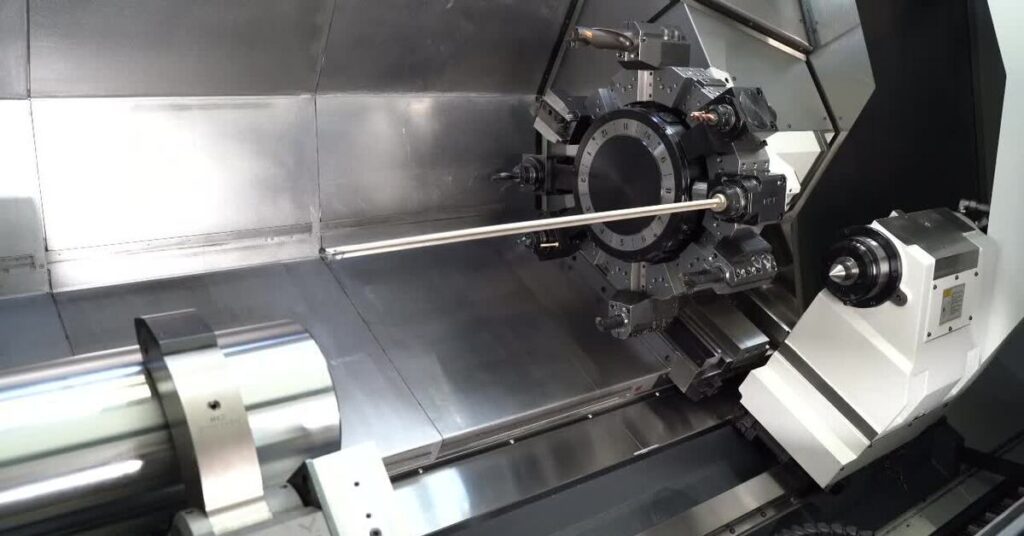
Deep hole drilling machines offer the required flexibility to create deep, precise holes with a high degree of straightness in a single operation. As such, this machine improves efficiency and structural part integrity in deep hole drilling operations by eliminating the need for multiple passes. CNC deep hole drilling machines possess features that allow adequate coolant flow, chip removal, and optimal stability during the drilling operation.
A CNC deep hole drilling machine has long, specialized cutting tools for making deep holes in a workpiece, irrespective of the material hardness. Moreover, its coolant-fed drills of deep hole systems are capable of handling deeper drilling operations. The specialized design of these machines and the high precision of CNC controls that minimizes deviation, guaranteeing the accuracy and superior quality of drilled holes even at greater depths.
Manufacturers in the medical, aerospace, and oil and gas industries rely on CNCdeep hole drilling machines in certain applications, like barrel and hydraulic system manufacturing, that require drilling deep holes with strict tolerances.
Bench-top CNC Drill Press
Bench-top CNC drill presses are versatile machines with a compact design, making them ideal for efficient and accurate drilling in small to medium-sized components. These types of drilling machines are ideal supplementary machines in larger CNC shops and for labs or workshops with limited space.
Even though these bench-top drill presses have a smaller size, they offer the precision of larger CNC drilling machines and can create holes at a range of speeds in different metals and plastics. Jewelry and medical device manufacturers often use bench-top drill press models to drill detailed and precise holes in parts.
Multiple Spindle Drilling Machine
Multiple spindle drilling machines feature a variety of drilling spindles that allow drilling of multiple holes simultaneously. Its design maximizes efficiency in large-scale production runs and minimizes cycle times since each spindle functions independently and can drill closely spaced holes or a variety of hole sizes and patterns in one pass.
You can configure this drilling machine type with the desired number of spindles to match the production needs, with each spindle adjustable depending on the spacing and drilling parameters. This machine is a staple in aerospace and automotive components manufacturing.

With 30 years of CNC experience, Sam is dedicated to solving complex design and machining challenges, ensuring precision and efficiency for every customer project.
[email protected]Best Practice for CNC Drilling
Skipping the dwell command (G04) in blind holes is a rookie mistake. Adding a half-second pause at the final depth gives the cutting edges time to finish the seat properly, ensuring the hole bottom is flat and dimensionally spot-on.
Contact Our CNC Machining ExpertTurret-type CNC Drilling Machine
The turret-type CNC drilling machine is known for its high precision and automation that allows it to minimize the risk of errors and maintain consistent hole quality. This drilling machine possesses a rotating turret comprising multiple tools, allowing for quicker tool changes and a range of drilling operations without requiring manual intervention.
The automated tool changer boosts productivity significantly by reducing setup time, especially in drilling operations that require holes of varying types and sizes. More so, turret-type CNC drilling machines feature advanced CNC controls for precise programming and perform complex drilling patterns suitable for prototyping and custom manufacturing of electronics parts and components of machinery.
Gang Drilling Machine
A gang drilling machine has a series of drilling spindles attached to a single table executing multiple drilling operations on a workpiece concurrently. The unique machine configuration helps minimize the need for multiple setups, optimize efficiency, and productivity. Consequently, it makes the gang drilling machine a standout choice for large-scale production runs.
Gang drilling machines feature multiple spindles, each of which you can operate independently or together based on the drilling requirements. The flexibility of the drilling spindles helps to achieve a range of hole sizes and patterns in a single setup, thereby reducing production times significantly. The high production rates and precision of this drilling machine make it vital in the automotive and electronics industries.
Radial Arm CNC Drill Press
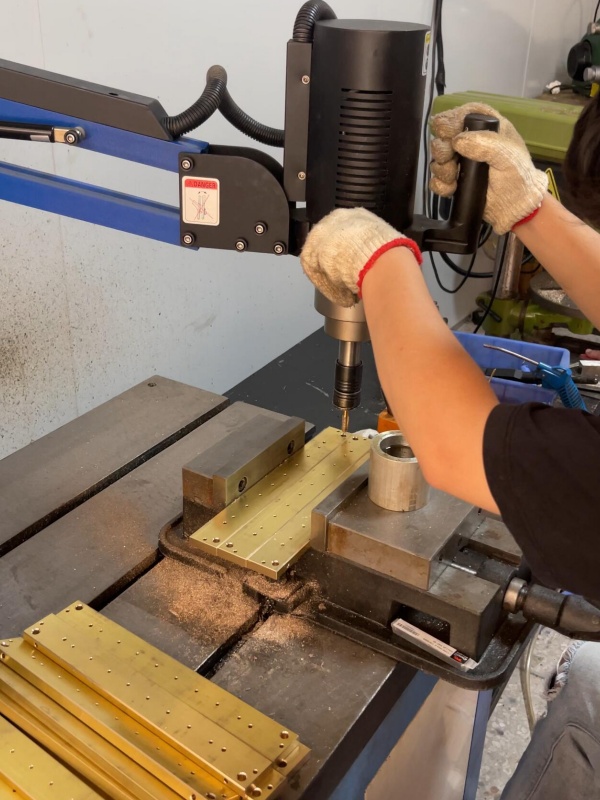

A radial arm CNC drill press features a spindle that moves along a radial arm, allowing greater flexibility and reach in various applications. This unique configuration of the CNC drilling machine allows for a movable and adjustable arm to create holes at various angles and positions on a workpiece, executing complex drilling tasks easily.
The versatility of the machine to move the spindle and drill holes in awkwardly shaped workpieces makes it ideal for custom drilling applications. Its precision and flexibility make it perfect for large-scale manufacturing processes.
Upright CNC Drill Press
Upright CNC drill press is a versatile drilling machine with a unique design and precise control system capable of handling complex drilling patterns and multiple drilling operations with high accuracy. The upright design of this machine enables it to work on small or large and tall workpieces, making it a commonly used machine in various drilling applications.
Upright CNC drill presses feature robust motors and an extensive range of spindle speeds, which allows for efficient drilling through material with varying thicknesses and hardness. They are indispensable in plastics, woodworking, and metal fabrication workshops.
Conclusion
CNC drilling is a widely embraced process in precision engineering for creating precise holes in various parts for industries. CNC drilling automates every aspect of the machining process, ensuring high accuracy, repeatability, and consistency in hole creation.
Don’t hesitate to contact AT Machining for structural components with intricate CNC drilling geometries, superior surface finishes, and holes drilled to exact specifications.AT Machining is a top CNC drilling services provider with cutting-edge technology to deliver efficient and consistent results. We pride ourselves on being able to stay ahead of the curve at every step.
We leverage our state-of-the-art facilities, advanced equipment, and techniques to tackle the most complex CNC milling, turning, drilling, and other precision machining operations. Upload your file to our easy-to-use platform and get an instant quote!