Skip to content
Key Differences Between Stiffness and Strength
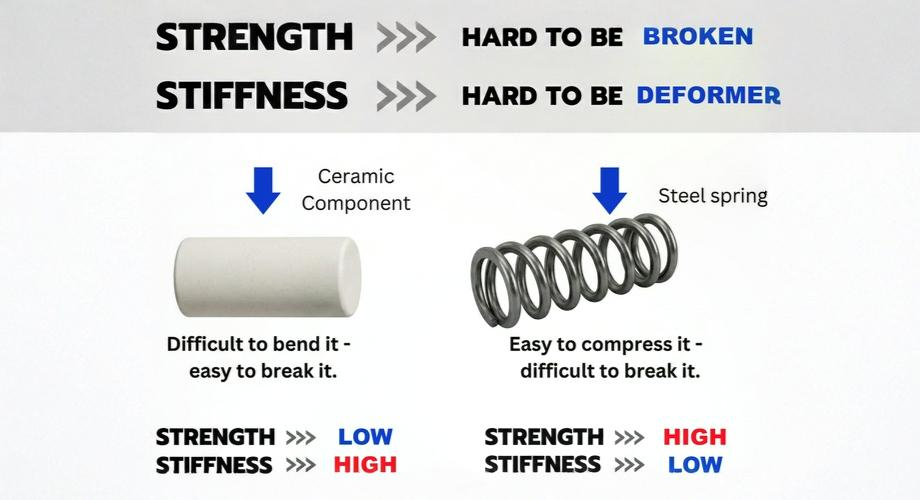
Stiffness is the resistance to elastic deformation. A stiff material deflects very little under load and returns to its original shape when you remove the force. Stiffness is defined by Young’s modulus, which measures the ratio of stress to strain. Steel has roughly three times the stiffness of aluminum.
Strength is the metal’s resistance to permanent deformation or failure. This property tells you how much stress a material can withstand before it yields or breaks. The strength of metals shows how much impact they can withstand before deforming or losing shape.
Here are some practical examples.
- A diving board needs flexibility (low stiffness) to bend and store energy, but also strength so it doesn’t break.
- A precision machine tool needs maximum stiffness to prevent deflection during operations.
Temperature affects the stiffness of metals, with increasing temperature leading to a decrease in stiffness. The composition of metal alloys significantly determines their stiffness.
Stiffness of Metal Material Chart
A stiffness chart is a graphical tool used in engineering to compare materials based on their resistance to elastic deformation relative to their weight. Stiffness in metals is defined by Young’s modulus, with steel being roughly three times stiffer than aluminum.
In a stiffness chart, the y-axis typically represents Young’s modulus, and the x-axis represents density. Logarithmic scales are used in stiffness charts because material properties span several orders of magnitude.
High-stiffness materials, such as tungsten and steel, typically appear at the top of stiffness charts. Metals are generally grouped in the upper-right quadrant of stiffness charts, indicating high stiffness and high density compared to polymers.
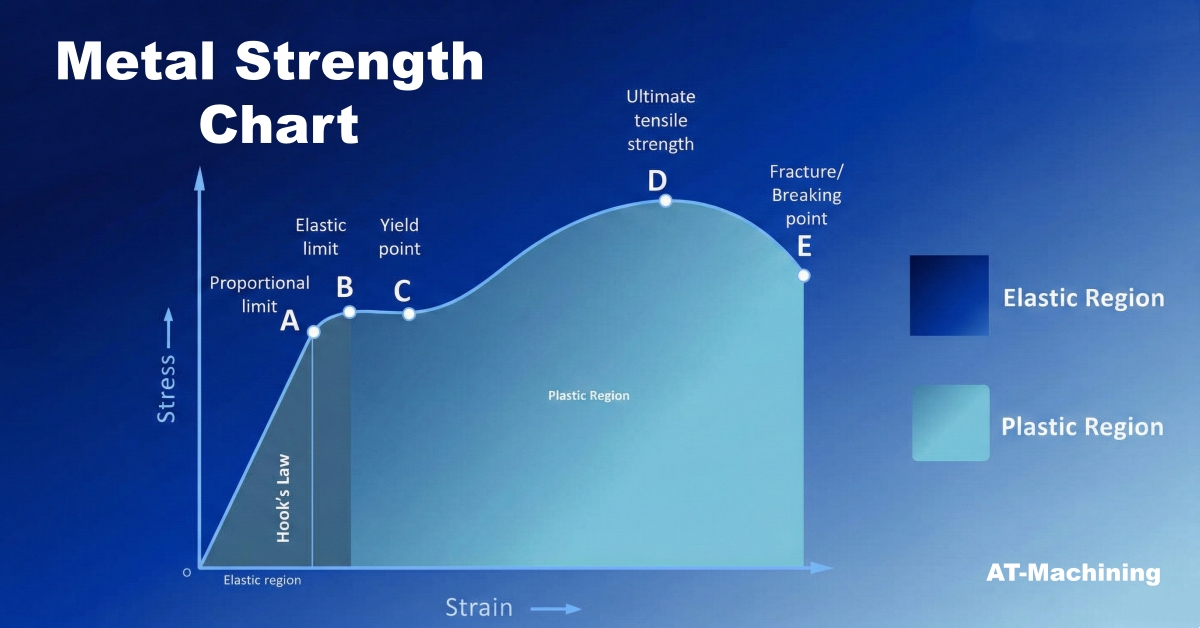
Young’s modulus is expressed in units of pressure, such as pascals (Pa) or pounds per square inch (psi). Young’s modulus is crucial for understanding how machining materials respond to applied forces and stresses. The initial slope of the stress-strain curve is Young’s modulus, representing the material’s behavior in the elastic region.
Materials towards the top-left of the stiffness chart, such as aluminum or titanium, have a high stiffness-to-weight ratio. Aluminum provides a higher specific stiffness than steel, making it better for lightweight, stiff designs. To achieve the same stiffness as steel, aluminum must typically be approximately 44% thicker, but the resulting structure may still be lighter.
Performance indices in stiffness charts allow engineers to select materials based on specific criteria for light, stiff beams. Stiffness analysis of materials and structures is an essential aspect of engineering design. The stiffness of a structure is determined by the elastic modulus of its constituent materials and other factors like geometric form and boundary conditions.
Beyond simple bending and axial loads, torsional stiffness measures a material’s resistance to twisting forces. This property matters significantly in rotating shafts, drive trains, and components subjected to torque. Applications like drive shafts and machine tool spindles require materials with high torsional stiffness to maintain precision and prevent excessive angular deflection under load.
Metal Strength Chart
A metal strength chart reveals how much load different materials can handle before permanent damage occurs. This comparison helps you evaluate metals based on multiple strength parameters alongside critical material properties.
| Metal Type | Tensile Strength (psi) | Yield Strength (psi) | Hardness (Rockwell B) | Density (kg/m³) |
| Stainless Steel 304 | 90,000 | 40,000 | 88 | 8,000 |
| Aluminum 6061-T6 | 45,000 | 40,000 | 60 | 2,720 |
| Aluminum 5052-H32 | 33,000 | 28,000 | 47 | 2,680 |
| Steel A36 | 58,000-80,000 | 36,000 | 119-159 | 7,800 |
| Steel Grade 50 | 65,000 | 50,000 | – | 7,800 |
| Brass | 54,000 | 40,000 | 55 | 8,470 |
| Copper | 32,000 | 28,000 | 10 | 8,940 |
| Titanium | 63,000 | 37,000 | 80 | 4,500 |
When you compare metal strength using this chart, several patterns emerge. Steel alloys dominate in terms of raw strength, with stainless steel 304 reaching 90,000 psi tensile strength. When you factor in weight, titanium and aluminum alloys offer compelling advantages for applications where reducing mass is critical.
Density plays a crucial role when comparing metals for weight-sensitive applications. Aluminum alloys weigh roughly one-third as much as steel. This weight advantage allows aluminum to compete with steel in many structural applications despite lower absolute strength values.
Steel is often used for construction and industrial purposes because of its high tensile strength and favorable cost-to-performance ratio. Carbon steel grades like A36 provide reliable strength at economical prices. When higher performance is needed, alloy steels offer increased yield strength.
Using a metal with low strength for a part meant for use in a weight-lifting crane can compromise the integrity of the part. Compare metals not only on strength but also on factors like corrosion resistance, thermal conductivity, and cost.
Young’s Modulus and Elastic Properties
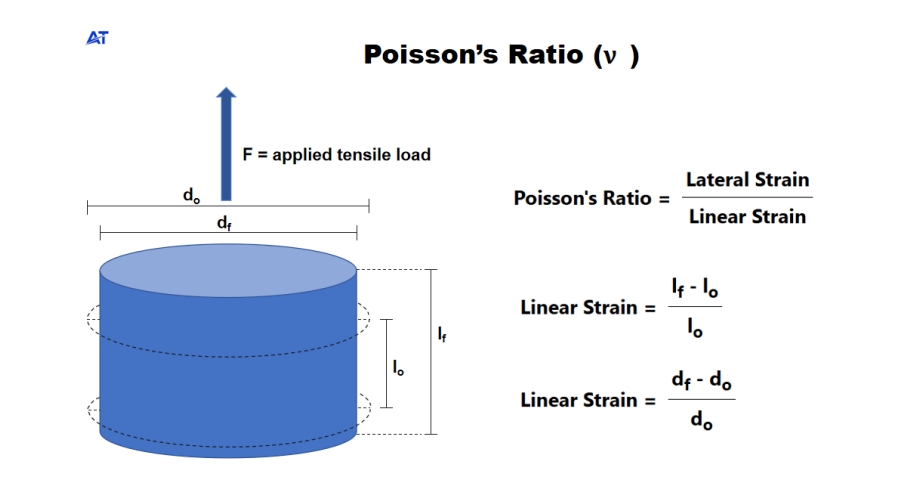
Young’s modulus is a measure of the stiffness of an elastic material, quantifying the relationship between stress and strain. Young’s modulus can be used to predict the elongation or compression of an object under stress. This predictive capability is essential for engineering design.
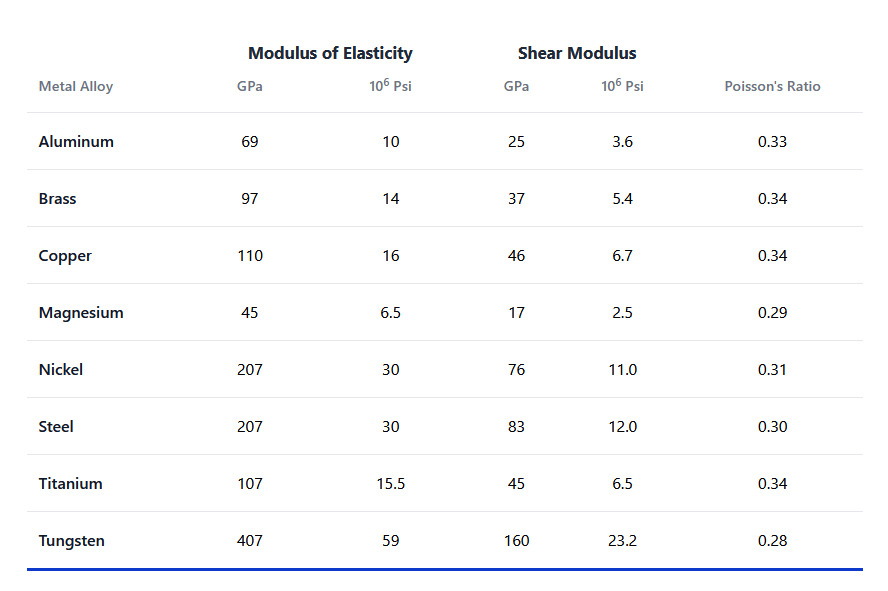
Young’s modulus values vary among different metals. Tungsten leads at 407 GPa, followed by steel and nickel at 207 GPa. Copper and titanium sit around 110 GPa, while aluminum is at 69 GPa and magnesium at 45 GPa. These variations reflect differences in atomic structure and bonding.
The tensile modulus remains essentially constant for a given metal regardless of heat treatment. Whether you heat-treat steel to increase its strength dramatically, its Young’s modulus stays near 200 GPa. Young’s modulus is a key factor in material selection for engineering applications.
Precision machine tools require extremely high stiffness to maintain accuracy during operations. Engineers select materials like steel for their high Young’s modulus values that minimize deflection. In contrast, suspension springs need high strength with moderate elastic modulus for sufficient elastic deformation. Elastic deformation is reversible. That is, the material will return to its original shape when you remove the load on it.
Tensile Strength Across Metal Materials
Tensile strength is the maximum amount of pulling or stretching that a metal can withstand without being permanently damaged. The ultimate tensile strength represents the peak stress a material can resist before it fractures.
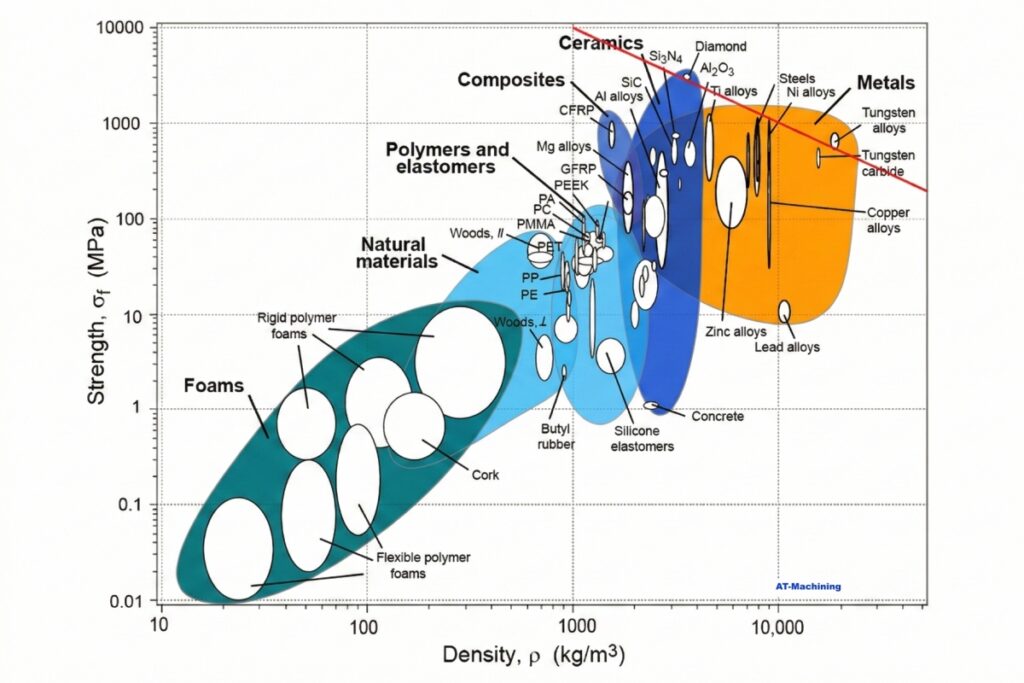
Steel demonstrates exceptional tensile strength across its various forms. Carbon steel reaches 400-550 MPa, while alloy steels and heat-treated grades exceed 1,200 MPa. Stainless steel Grade 304 offers 90,000 psi (620 MPa) with corrosion resistance. This versatility makes steel the material of choice when maximum strength is required.
Aluminum alloys provide respectable tensile strength at a fraction of steel’s weight. Aluminum 6061-T6 has 45,000 psi (310 MPa) tensile strength. While this is roughly half that of structural steel, aluminum’s lower density means it often performs better in strength-to-weight comparisons.
Titanium offers an excellent balance of high strength and light weight. With tensile strength around 63,000 psi (434 MPa) for commercial grades, titanium competes with steel while weighing 40% less. This combination makes titanium valuable for aerospace, medical, and marine applications.
Yield strength is the strength a metal can withstand without permanent deformation. Engineers calculate yield strength to determine the maximum load an object can accommodate. External force applied to a component creates internal stress, and the material’s tensile strength determines whether it can safely resist this stress without failure.
Compressive Strength in Metal Materials
Compressive strength refers to the maximum amount of pressure or compression a metal can withstand without damage. This property is particularly important for components that experience crushing forces, such as columns, supports, and structural beams.

The compressive strength of steel is typically higher than its tensile strength, meaning it can withstand more force in compression than in tension. Carbon steel can handle compressive stresses exceeding 250 MPa, while high-strength structural steels reach 400-500 MPa or more.
Different steel grades offer varying compressive performance. Mild steel (A36) has compressive strength around 250 MPa for general structural work. High-strength steel (Grade 50) exceeds 345 MPa for demanding applications. Heat-treated alloy steels can reach 500-700 MPa for specialized high-load components.
Aluminum alloys demonstrate good compressive strength relative to their weight. Aluminum 6061-T6 has a compressive yield strength of approximately 276 MPa, similar to its tensile yield strength. This balanced performance makes aluminum suitable for both tension and compression members in lightweight structures.
External pressure on a structure creates compressive stress in supporting members. Buildings, bridges, and towers rely on columns and supports with adequate compressive strength to carry loads safely. Engineers must account for both material strength and buckling.
Bending moments in beams create both tension and compression. The top surface of a simply supported beam under load experiences compression, while the bottom surface experiences tension. Material selection must consider both stress types.
Impact Strength and Energy Absorption
Impact strength measures a metal’s ability to resist fracture when subjected to sudden, high-energy loads. The Charpy and Izod impact tests measure this property by striking a notched specimen with a pendulum. The energy absorbed during fracture indicates the material’s toughness.

High impact strength materials absorb energy through plastic deformation before fracturing. Steel’s impact strength varies dramatically with temperature. At room temperature, mild steel absorbs 60-120 J in tests. However, as temperature decreases, steel undergoes a ductile-to-brittle transition with sharply reduced impact strength.
Aluminum alloys maintain good impact strength across a wide temperature range without a ductile-to-brittle transition. This makes aluminum reliable for cold-climate structures. Titanium alloys offer exceptional impact strength combined with high strength-to-weight ratios. Stainless steel shows lower impact strength than carbon steel at room temperature, but maintains better performance at temperature extremes.
Toughness combines strength with ductility to indicate overall damage resistance. A tough material has both high strength to resist deformation and sufficient ductility to absorb energy.
Factors Affecting Metal Strength and Stiffness
Different factors influence how metals perform under stress and load.
Alloy Composition and Chemical Elements
The composition of metal alloys significantly determines their stiffness and strength. Carbon content dramatically impacts steel properties. Low-carbon steel offers good ductility with moderate strength, while high-carbon steel achieves maximum hardness but becomes brittle.
Alloying elements serve specific functions. Chromium provides corrosion resistance in stainless steel. Nickel enhances toughness. Molybdenum increases high-temperature strength. Aluminum alloys depend heavily on alloying elements, with pure aluminum being soft but alloys reaching tensile strengths exceeding 500 MPa.
Temperature Effects
Temperature affects the stiffness of metals, with increasing temperature leading to a decrease in stiffness. Steel maintains useful strength up to about 400°C. Aluminum alloys are more temperature-sensitive and should not be used above 150°C for extended periods. Cold temperatures generally increase strength but may reduce toughness.
Heat Treatment Processes
Heat treatment procedures can change the microstructure of metals, affecting their properties dramatically. Quenching followed by tempering can increase steel yield strength from 250 MPa to over 1,200 MPa. Aluminum alloys respond to solution treatment followed by aging, causing precipitates to form that dramatically increase strength.
Microstructure
The arrangement of grains and dislocations within metals determines their stiffness and strength. Finer-grained metals are generally stronger. Cold working increases strength by introducing dislocations.
Surface Engineering and Mechanical Enhancement
Surface treatments can influence the stiffness of metal materials by adding extra layers. Shot peening creates compressive residual stress, potentially doubling fatigue life.
Comparing Common Metals: Steel, Aluminum, Titanium
There are different types of metals for various applications. However, three metal families dominate modern engineering, each offering distinct advantages.

Steel: Maximum Strength and Stiffness
Steel remains the workhorse material for structures requiring maximum strength and stiffness at reasonable cost. With Young’s modulus of 200 GPa, steel is roughly three times stiffer than aluminum. Carbon steel offers excellent properties at low cost (roughly $0.50-1.00 per pound). Alloy steels extend performance with yield strengths exceeding 1,000 MPa. Stainless steel combines corrosion resistance with 215 MPa yield strength. Steel’s primary disadvantage is its weight at 7,800-8,000 kg/m³ density.
Aluminum: Lightweight Performance
Aluminum alloys weigh about one-third as much as steel at 2,700 kg/m³. Aluminum provides a higher specific stiffness than steel, making it better for lightweight, stiff designs. Aluminum 6061-T6 offers 276 MPa yield strength with good corrosion resistance. Aerospace-grade 7075-T6 reaches 505 MPa yield strength. Aluminum excels in corrosion resistance through its passive oxide layer and offers excellent thermal conductivity for heat dissipation applications.
Titanium: Premium Performance
Titanium weighs about 60% as much as steel (4,500 kg/m³) while maintaining comparable strength. Ti-6Al-4V offers 830-925 MPa yield strength. Titanium forms an extremely stable oxide layer, providing superior corrosion resistance. Biocompatibility makes titanium ideal for medical implants. Disadvantages include cost ($15-30 per pound) and difficult machinability.
Selecting the Right Metal for Your Application
Effective material selection requires systematic evaluation. Define requirements by establishing what the component must achieve. Load analysis determines required strength and stiffness. Environmental conditions constrain material choices.
Consult comprehensive metal strength charts to compare candidate materials across relevant properties. Consider strength-to-weight ratios for weight-sensitive applications. Manufacturing feasibility impacts selection significantly. Some materials machine easily while others challenge standard tooling.
Balance cost and performance. Processing costs often exceed material costs, particularly for difficult-to-machine materials. Consider complete life cycle costs. Verify the selected material meets all requirements using appropriate safety factors. Testing validates selections for critical applications.
Stiffness is essential for maintaining structural integrity in buildings, bridges, and other structures. In product design and engineering, stiffness is important for achieving precision. The stiffness of metal materials is crucial for load distribution in structures to prevent local stress concentrations.
Conclusion

Understanding metal strength and stiffness is fundamental to successful engineering. A comprehensive metal strength chart provides the data needed to compare different metals and select materials that meet specific requirements. Young’s modulus defines stiffness, ranging from 45 GPa for magnesium to 407 GPa for tungsten. Strength properties vary widely across different metals.
Steel offers maximum strength and stiffness at low cost. Aluminum provides excellent strength-to-weight ratios with good corrosion resistance. Titanium delivers premium performance, combining high strength, light weight, and superior corrosion resistance. Stiffness is essential for maintaining structural integrity, while stiffness control suppresses vibrations in structures and machinery.
AT Machining specializes in working with a wide range of metal materials. Our expertise in metal CNC machining enables us to help you select and process the right metal for your application. Contact us today to discuss your project requirements and material selection needs.